

Showing posts with label math. Show all posts
Showing posts with label math. Show all posts
Monday, October 22, 2018
The Day I Was A Good Teacher Effectively Using Formative Assessments
I would absolutely love to highlight the homo(yet also hetero)geneous grouping strategy I utilized last week. Allow me to explain. I ordered students based off of their last assessment grades. Lowest to highest. Lowest grades were in the front row, lucky them! High scorers were in the back row. They independently worked on a 2 question, yet really challenging, formative assessment. After 7 minutes of silent practice, I allowed them to work with their partners. Their partner was of a very similar ability level, yet students were really able to help each other out. This is where it gets good! The class was split into 3 chunks of 3-4 rows of partnerships. SO, when partners could no longer help each other, they turned down their row and so on and the people in the back were the experts. DO YOU GET THE MAGIC?? I circulated and watched students teach students.


Wednesday, April 11, 2018
Bird Family Question
During small groups today, I verbally gave my third graders the following question that I so skillfully made up in a few seconds.
Suppose there are 40 bird families in Tucson. A bird family consists of a Mom Bird, a Dad Bird, and 2 kids birds. 18 bird families fly away to Phoenix. How many kid birds are left in Tucson?
Allow me to list the mathematical practices that this task required:
MP1 Make sense of problems and persevere in solving them
MP 2 Reason abstractly and quantitatively
MP 3 Construct viable arguments and critique the reasoning of others
MP 4 Model with mathematics
MP 5 Use appropriate tools strategically
MP 6 Attend to precision
MP 7 Look for and make use of structure
MP 8 Look for and express regularity in repeated reasoning
Huh. I honestly didn't know I would list out all eight. Oh well! If the shoe fits...
My group of three girls made me so proud! They're getting used to (finally!) my persistent questioning and demands that they represent their work in multiple ways. With little prompting, here are some pictures of what they came up with.
 Student A (we'll call her Jessica) ended up drawing 22 circles to represent a "family." She then drew four dots to represent each bird and crossed out the adults since my initial question only required her to find how many kids were left.

Similarly, Student B (let's say, Anna) showed represented the situation similarly, but didn't even draw the two "adult" dots since she said they didn't matter. She had more difficulty counting the two dots, so she grouped the families to keep track of how many bird kids she was counting.
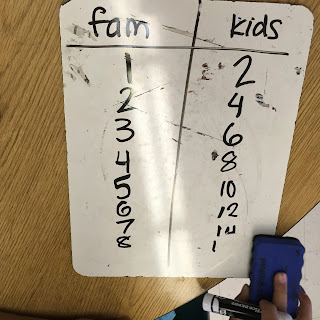
Lastly, Student C ("Danielle"), was able to identify the first step as "subtraction," but struggled at first with picturing the situation. She came up with "22" but couldn't identify if that was bird of bird families. After a group discussion, she decided that there were 22 bird families left. In order to figure out how many kids that was, she made the chart and continued it onto 3 whiteboards (not pictured).
Suppose there are 40 bird families in Tucson. A bird family consists of a Mom Bird, a Dad Bird, and 2 kids birds. 18 bird families fly away to Phoenix. How many kid birds are left in Tucson?
Allow me to list the mathematical practices that this task required:
MP1 Make sense of problems and persevere in solving them
MP 2 Reason abstractly and quantitatively
MP 3 Construct viable arguments and critique the reasoning of others
MP 4 Model with mathematics
MP 5 Use appropriate tools strategically
MP 6 Attend to precision
MP 7 Look for and make use of structure
MP 8 Look for and express regularity in repeated reasoning
Huh. I honestly didn't know I would list out all eight. Oh well! If the shoe fits...
My group of three girls made me so proud! They're getting used to (finally!) my persistent questioning and demands that they represent their work in multiple ways. With little prompting, here are some pictures of what they came up with.


Similarly, Student B (let's say, Anna) showed represented the situation similarly, but didn't even draw the two "adult" dots since she said they didn't matter. She had more difficulty counting the two dots, so she grouped the families to keep track of how many bird kids she was counting.
Lastly, Student C ("Danielle"), was able to identify the first step as "subtraction," but struggled at first with picturing the situation. She came up with "22" but couldn't identify if that was bird of bird families. After a group discussion, she decided that there were 22 bird families left. In order to figure out how many kids that was, she made the chart and continued it onto 3 whiteboards (not pictured).
Saturday, February 24, 2018
Conceptual Teaching and Learning of Math
Ramblings: When I was a wee undergraduate student, I was a research assistant to a math education professor. My thesis had a title with words like "novel," "linear relationship," and "student thinking."Basically, for a year I was immersed into the idea that conceptual understanding is paramount in math education. And I totally drank the Kool-Aid. A professional goal I set for myself most ears is to try and incorporate as much conceptual understanding into each lesson as possible. However, with district and state tests, sometimes it can be very overwhelming to teach students conceptual understanding, make sure that develops into fluency, ensure students able to apply said concepts to new situations, and teach test-taking strategies. It is so exhausting. Huh, I just realized this whole spiel wasn't even related to what I wanted to post about: an excellent problem I did with 3rd grade. I guess I just needed to vent! Here begins my real post:
Last week, I started reading Principal Actions: Ensuring Mathematical Success for All, which is a National Council of Teachers of Mathematics (NCTM) publication. Of course they promote this conceptual understanding of mathematics and encourage giving students real-world scenarios, letting them experience a "productive struggle," work collaboratively and solve the problem in many ways. I gave my 3rd graders the following problem from the book:
There's going to be a talent show and the principal wants to set up 7 rows with 20 chairs in each row, and possibly an aisle down the middle for people to walk. How many chairs should she order to be pulled out of storage?
I didn't print this out and give this to them on a worksheet. I had a small group of 3 students (of similar ability levels) and gave them the question verbally. They were to tell me how they thought they could solve it before they started to write it on individual whiteboards. I was SO impressed with what they came up with. Between the three of them, they were able to represent the situation with a picture, counting by 10s, counting by 20s, and with a multiplication equation. It even concluded with two of the students representing the solution in various ways after I kept questioning.

This activity reminded me that it is not too difficult to incorporate conceptual-based tasks into your day. This one was about 10-15 minutes and it let me spend time with 3 students while the rest were on computers working independently on subtraction fluency. The students enjoyed this, and I can't wait for Monday to pull a new group of 3 students to see how they wow me.
Happy weekend!
Disclaimer (not sure if I need one or not): I am NOT affiliated in any way with NCTM. I just enjoy reading the book and have learned a lot!
Last week, I started reading Principal Actions: Ensuring Mathematical Success for All, which is a National Council of Teachers of Mathematics (NCTM) publication. Of course they promote this conceptual understanding of mathematics and encourage giving students real-world scenarios, letting them experience a "productive struggle," work collaboratively and solve the problem in many ways. I gave my 3rd graders the following problem from the book:
There's going to be a talent show and the principal wants to set up 7 rows with 20 chairs in each row, and possibly an aisle down the middle for people to walk. How many chairs should she order to be pulled out of storage?
I didn't print this out and give this to them on a worksheet. I had a small group of 3 students (of similar ability levels) and gave them the question verbally. They were to tell me how they thought they could solve it before they started to write it on individual whiteboards. I was SO impressed with what they came up with. Between the three of them, they were able to represent the situation with a picture, counting by 10s, counting by 20s, and with a multiplication equation. It even concluded with two of the students representing the solution in various ways after I kept questioning.
This activity reminded me that it is not too difficult to incorporate conceptual-based tasks into your day. This one was about 10-15 minutes and it let me spend time with 3 students while the rest were on computers working independently on subtraction fluency. The students enjoyed this, and I can't wait for Monday to pull a new group of 3 students to see how they wow me.
Happy weekend!
Disclaimer (not sure if I need one or not): I am NOT affiliated in any way with NCTM. I just enjoy reading the book and have learned a lot!
Subscribe to:
Posts (Atom)
The Day I Was A Good Teacher Effectively Using Formative Assessments
I would absolutely love to highlight the homo(yet also hetero)geneous grouping strategy I utilized last week. Allow me to explain. I ordere...
-
 I would absolutely love to highlight the homo(yet also hetero)geneous grouping strategy I utilized last week. Allow me to explain. I ordere...
 -
Is it lame to post twice in one day? Probably. But I still have energy and zest so I'm at it again! I was feeling nostalgic for my being...
-
I found a new website and I fell in love with it! Found it last night whilst scrolling through teacher Instagrams and tried it out today. It...
